When you dive into methods for managing tasks and to-dos, one thing you quickly notice is how people struggle to describe the difference between the two words. Does “task” mean something different from “to-do”?
This article summarizes what dictionaries, productivity resources in Japan and overseas, and our own experience at Task Management Partner have taught us.
Depending on the article you read, some say “tasks are for today and to-dos are for later”, while others flip the definition. Some even draw the line by asking whether a fixed deadline exists!
In short, plenty of explanations contradict one another.
Exactly. The meaning shifts depending on who is speaking and which cultural context the words are used in.
In Short: Treat Them Both as “Things to Do”
If your team or community has an agreed definition, follow it. Outside of that, it is perfectly fine to treat “task”, “to-do list”, and “task list” as loose synonyms for “work you want to get done”. Language always evolves.
Below I will take a closer look at each word from the viewpoint of a task management professional.
How “Task” and “To-Do” Differ
Both terms come from English, so let us start with dictionary definitions.
What Is a Task?
A task is simply a piece of work. It does not have to be limited to your job—it can include household chores, studying, hobbies, or rest. Because task management is often used in a work setting, I will use “work” as shorthand, but you can read it more broadly.
Some example dictionary wording:
- A piece of work done as part of one’s duties.
What Is a To-Do?
A to-do is a task that has not yet been completed—in other words, something you still plan to do. Dictionaries often explain it as:
- A task yet to be done; an item on a to-do list.
A Subset Relationship
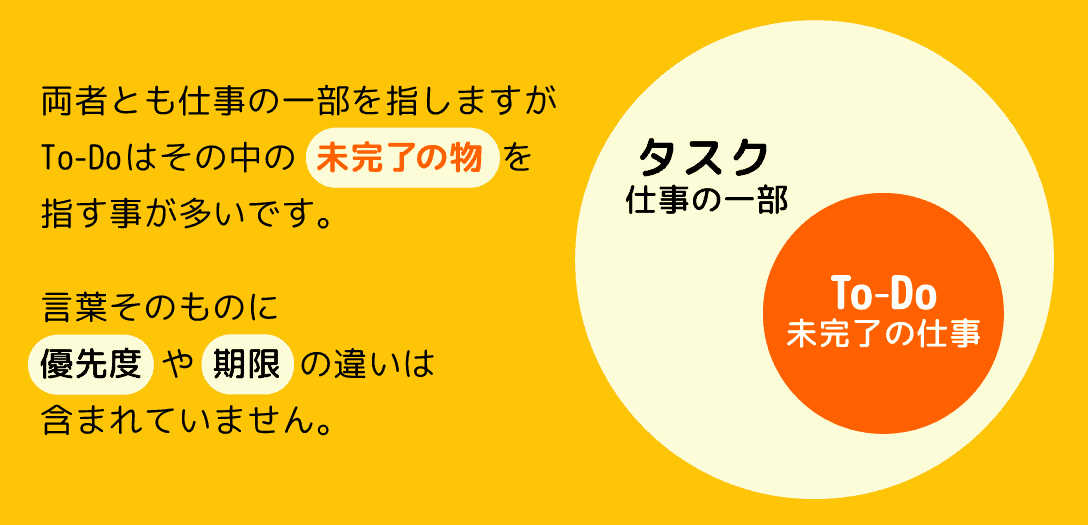
Putting the two definitions together, “task” is the broader word. It covers both work that already finished and work that still lies ahead. “To-do” refers specifically to the unfinished items. You can think of it as “tasks” being the whole set and “to-dos” being the subset of tasks that remain.
Nothing in these definitions says that a to-do must have a deadline, a priority, or a specific level of urgency. Those traits can exist, but they are not part of the core meaning.
You may have seen software or operating systems say “Task completed” or “Task in progress”. That wording makes sense because the computer is reporting on work it is carrying out. You would rarely see the same message phrased with “to-do”.
Does Adding “List” Change Anything?
The definitions get even blurrier once you add “list”. “Task list” is often described as a list of errands and tasks, while “to-do list” is described as a list or database of tasks that should be completed. Depending on the source, “to-do list” can even appear broader than “task list”.
In practice you will find writers, teams, and apps that use the terms interchangeably. Rather than hunting for a hard rule, focus on how your own team wants to use them.
Do Not Get Stuck on Terminology
Every client who works with Task Management Partner brings their own nuance to these words. What matters most is not polishing the terminology—it is helping you keep your lists moving so you can achieve your goals.
It is great to care about language, but do not let that stop you from taking action. Instead, gently remind yourself to pick up the next unfinished task and move it forward.
If you would like someone to think through questions like these with you, that is what our service is for. We offer support plans such as the Basic Support Plan, the Full Support Plan with daily calls, and the Message Support Plan with twice-daily check-ins. We would love to help you keep your task list moving.