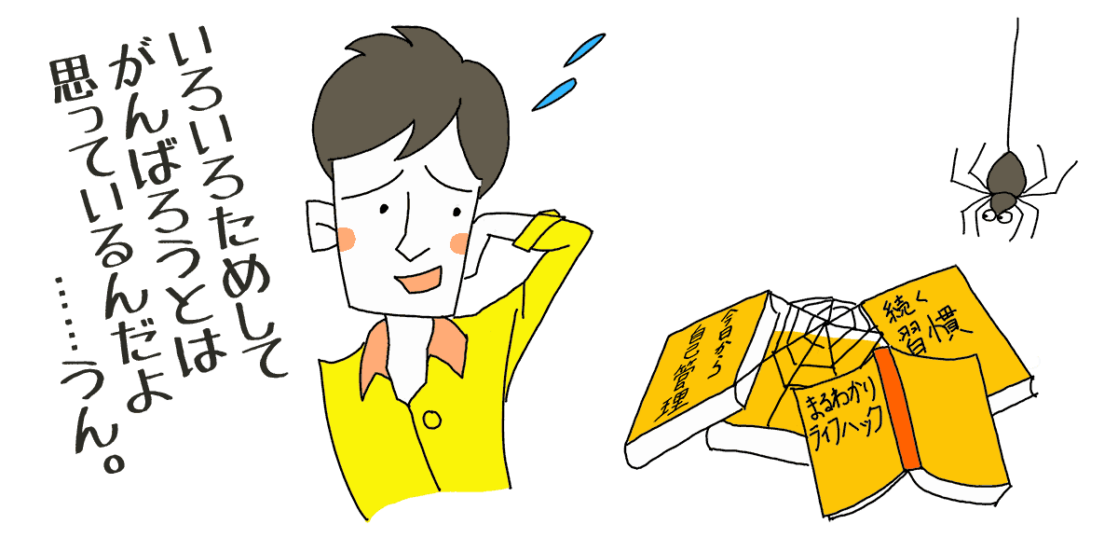
- Every day a flood of new tasks arrives and the sheer volume leaves you spinning your wheels.
- You can tell, at least vaguely, what needs to be done, yet the picture stays fuzzy and your hands just will not move.
People who struggle with task management come from many different situations, but they usually share two characteristics.
- They are not naturally good at structuring and tracking tasks.
- They know that what they really need is reliable task management.
They try a variety of methods in search of the perfect system, only to give up again and again because nothing sticks for long.
The most effective way for people in this loop to keep task management going is to stop trying to manage everything by themselves.
If you found this article because you were searching for a better method, chances are that task management just is not your forte.
If it were, you would already be doing it smoothly without all that research or brute-force effort.
Everyone Has Strengths and Weaknesses
Some people draw beautifully, some excel at games, others shine in the kitchen. We all have areas where we seem to glide forward without much practice.
The opposite is also true: even with deliberate effort, the things we are bad at rarely become easy. If a little ingenuity were enough, bookstores would not need entire shelves of dieting guides.
Task management is no different. For some people it comes naturally; for others it stubbornly refuses to take root no matter how much they try.
Poor Task Management Is a Costly Weakness
You can ignore some weaknesses without major consequences, but task management is not one of them.
If you cannot draw, the impact is mostly limited to art class. Once you become an adult, you can go about daily life with barely a sketch. Task management, however, directly affects how smoothly you live and work.
Even a talented illustrator will struggle to earn a steady living if they cannot plan their days, meet deadlines, and keep promises. The loss caused by weak task management is immeasurable, especially at work.
So while everyone has strengths and weaknesses, some skills simply cannot be abandoned. Task management belongs in that “must keep” category.
Why, then, is letting go of control the smartest move?
Hand the Management Over to Someone Else
If task management is not your strong suit, forcing yourself to master it with hacks and willpower rarely works for long. Determination is not the issue.
That is exactly why the Task Management Partner service exists. You still create and execute your tasks, but a partner checks your shared list, talks with you every day via call or message, and helps you organise the next steps. With that support you move forward far more reliably than by gritting your teeth alone.
Cost can be a concern. If so, try setting up a system where a family member, friend, or colleague takes on that supporting role.
If You Ask Someone Close to You
When you ask someone in your circle to help, the one rule you must respect is to avoid turning it into a casual “do me a favour.” Once that dynamic appears, the support structure collapses.
The best way to prevent that is to pay them, even a modest amount. A fee—lower than ours is fine—creates responsibility and makes it easier to keep the check-ins going long term. Naturally, you will need someone who already shows a certain level of self-management.
You might also consider a peer-to-peer arrangement where you each check on the other. When it works it can be great, but in practice it often fizzles out, so keep that in mind.
Let us build a structure that lets you focus on your strengths. The Basic Support Plan is a great starting point, and if you want daily calls or faster results, take a look at the Full Support Plan.